

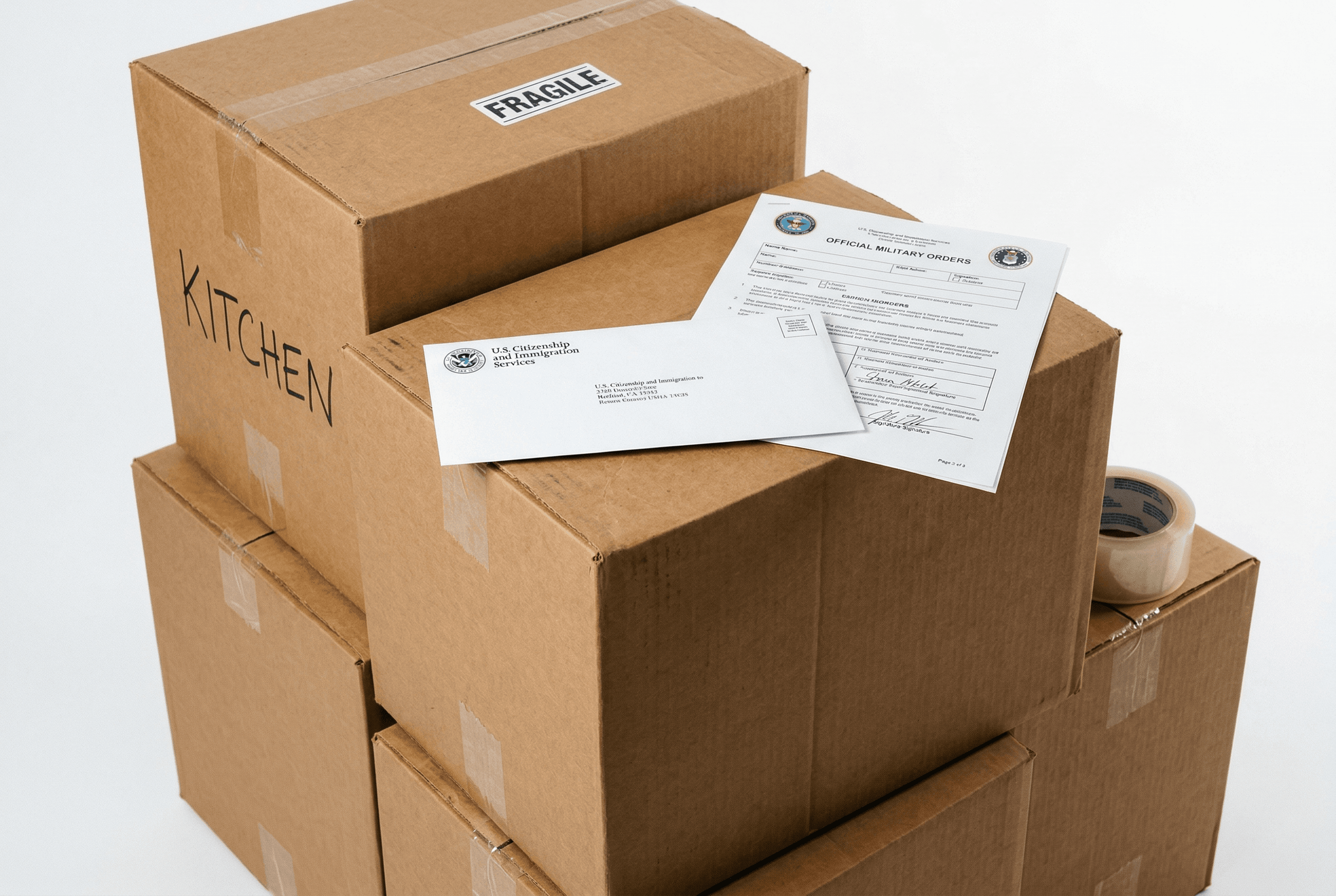
Orders change. Your case strategy shouldn't fall apart when they do.
A PCS (Permanent Change of Station) is stressful enough when you're just dealing with movers, housing, and school enrollment. Add a pending immigration application to the mix and the anxiety multiplies. What happens to your green card interview? What about the RFE you just received? Does your case start over?
The short answer: no, it doesn't start over. But there are steps you need to take, and timing matters.
The First Thing to Do: Update Your Address
This sounds basic, but it's the most common mistake military families make during a PCS. If USCIS sends a notice to your old address and you don't respond, they can deny your case for abandonment.
PCS Moves and Pending Immigration Cases: What Really Happens
Orders change. Your immigration strategy shouldn’t fall apart when they do.
A PCS (Permanent Change of Station) is stressful enough when you’re juggling movers, housing, and school enrollment. Add a pending immigration application and the anxiety multiplies:
- What happens to your green card interview?
- What about the RFE that just arrived?
- Does your case start over?
The answer: no, your case does not start over. But there are steps you need to take, and timing matters. USCIS has processes for military families who move mid-case. They’re not always fast or intuitive, but they exist. The key is knowing what to do and when.
Step One (Always): Update Your Address
This sounds basic, but it’s the most common mistake military families make during a PCS. If USCIS sends a notice to your old address and you don’t respond, they can deny your case for abandonment.
You are legally required to file an AR-11 (Alien’s Change of Address Card) within 10 days of moving. This applies to every noncitizen in the household, not just the primary applicant.
What to do after a PCS:
- File the AR-11 online through the USCIS website
- Update your address in your USCIS online account (the AR-11 alone may not update pending cases)
- Call the USCIS Contact Center and confirm the new address is linked to each pending case receipt number
- Notify your attorney so they can update their records and follow up with USCIS directly
Many families assume the AR-11 automatically updates everything. It doesn’t always. Your USCIS online account and a confirmation call are separate, critical steps that help prevent missed notices.
How USCIS Jurisdiction Transfers Work
When you PCS to a new duty station, your pending case may need to transfer from one USCIS field office to another. This is called a jurisdiction transfer.
Here’s what actually happens behind the scenes:
- USCIS assigns your case to a field office based on your address at the time of filing
- When you update your address, USCIS reviews whether the case should transfer to the office that covers your new location
- Local field office cases (like adjustment of status interviews) usually transfer
- Service center cases (like many I-130s in initial processing) usually do not move just because you PCS
- Transfer timelines vary widely: some transfers happen in weeks, others take months
A jurisdiction transfer can add processing time because your case enters the new office’s queue. But leaving your address unchanged and trying to travel back for appointments creates its own risks, including missed mail and potential denials.
For most military families, the safer strategy is to update the address promptly and accept the transfer, rather than trying to “game” the system with an old address.
PCS, Scheduled Interviews, and Biometrics
This is where PCS orders cause the most immediate stress: you have an interview scheduled, but your report date is before the appointment.
If you haven’t PCS’d yet
- Call the USCIS Contact Center and request to reschedule the interview
- Clearly explain the military orders and PCS date
- Your attorney can also send a written reschedule request with a copy of your PCS orders
USCIS is generally accommodating when military orders are involved, especially when you give them notice.
If you’ve already moved
- The interview will likely need to transfer to your new field office
- You’ll receive a new interview date at the new location
- This can take time, so file your AR-11 and update your address immediately to start the transfer process
Biometrics appointments
Biometrics are more flexible:
- Biometrics can usually be completed at any Application Support Center (ASC) nationwide
- If you PCS before your biometrics date, you can request to reschedule at an ASC near your new duty station
Because servicemembers and their families can sometimes qualify for expedited processing, an expedite request may help speed up rescheduling of interviews and biometrics in urgent situations.
RFEs During a PCS: Why Timing Is Critical
An RFE (Request for Evidence) is a letter from USCIS asking for more documentation. RFEs come with a strict deadline (often 87 days from the date on the notice). That clock does not stop because you’re moving.
If the RFE goes to your old address, you may not see it until the deadline has passed. That’s one of the highest-risk scenarios for a family in transit.
Protect yourself by:
- Updating your address immediately (AR-11 + online account + Contact Center)
- Making sure your attorney is properly listed as your representative (USCIS sends RFE copies to the attorney of record)
- Using your attorney’s office as a stable mailing point if you’re between addresses during a PCS
- Responding to RFEs as quickly as possible, even if you’re on the road—your attorney can coordinate and submit from anywhere
It’s entirely possible to handle an RFE while you’re driving cross-country to your next duty station, as long as you have a centralized legal team tracking deadlines and documents.
Expedited Processing Options for Military Families
USCIS has a formal process for expedited handling, and active-duty military service is one of the recognized bases for requesting it.
How to request an expedite:
- Call the USCIS Contact Center or submit a written request through your USCIS online account
- Include copies of military orders, deployment notices, or PCS documentation
- Clearly explain the specific urgency, such as:
- Needing to complete an interview before a PCS date
- Upcoming deployment that will make you unavailable
USCIS reviews expedite requests case by case. Military orders strengthen your request, but approval is not guaranteed.
An expedite doesn’t mean a decision next week; it means your case is prioritized within the queue. For many military families, that can shave weeks or months off processing—often enough to resolve a case before a PCS instead of dragging it across multiple moves.
For broader strategy on aligning immigration steps with deployments, see our deployment timeline planning guide (/military-immigration/deployment-timeline-planning).
When to File Around a PCS: Before or After?
If you know a PCS is coming, the natural question is: Should we file now, or wait until after the move?
Consider filing before the PCS if:
- You’re early enough that USCIS is likely to adjudicate before you move
- Your current location has shorter processing times than your destination
- You want to lock in your filing date for priority date or other timing reasons
Consider waiting until after the PCS if:
- The move is imminent (within 30–60 days) and filing now would almost certainly trigger a mid-move transfer
- Your destination field office has shorter processing times
- You need to establish new state residency for certain benefits or filings
A practical rule of thumb
- More than 6 months before PCS: usually makes sense to file now
- Less than 2 months before PCS: often better to wait
- Between 2–6 months: depends on case type, offices involved, and your family’s specific circumstances
There’s no one-size-fits-all answer. That’s where an attorney familiar with military timelines and PCS patterns can help you choose the least disruptive path. Our PCS and immigration guide (/military-immigration/pcs-moves-and-immigration) walks through this decision framework in more detail.
How Occam Supports Military Families
You’ve already dealt with DEERS, TRICARE, and PCS paperwork. USCIS shouldn’t be the system that breaks you.
At Occam, our process is built around the reality that military families move:
- Your attorney stays with you across duty stations—you don’t get reassigned just because you PCS
- We handle address changes, jurisdiction transfers, and appointment rescheduling as part of our standard workflow
- RFE responses go through our office, giving you a stable point of contact even when you’re between addresses
- We track military timelines alongside immigration timelines so critical dates don’t slip through the cracks
If you’re facing a PCS with a pending immigration case—or planning ahead and want to time your filing strategically—we can help you build a plan that assumes your orders will change and keeps your case on track anyway.
Visit our military immigration page (/military-immigration) to learn more about how we work with servicemembers and their families, or start with military immigration 101 (/military-immigration/military-immigration-101) for a broader overview of the process.