
Introduction
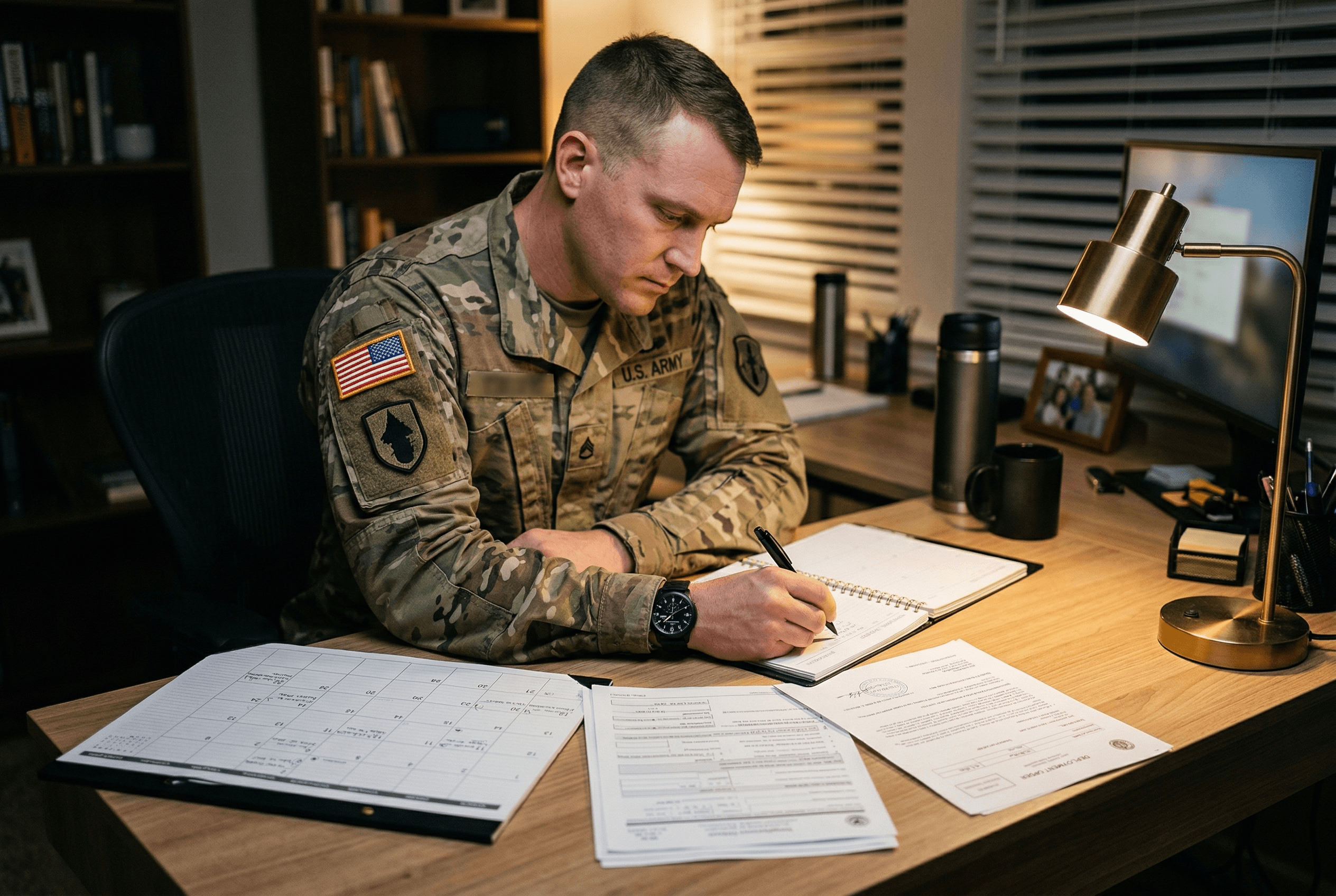
Deployment is one of the biggest variables in military immigration. When you receive orders, the immediate focus is on mission preparation, family logistics, and the hundred other things that come with leaving home for months. Your immigration case can easily fall to the bottom of the list, and that's when cases stall, deadlines slip, and what should have been a straightforward process turns into a months-long delay.
The good news: with structured planning, your case doesn't have to stall. Military families who plan around deployment, filing strategically, setting up Power of Attorney, understanding their SCRA protections, and establishing communication protocols, keep their cases moving even while overseas. This guide walks through each of those steps so you know exactly what to do before, during, and after deployment.
Filing Before Deployment
Why Timing Matters
The single most impactful thing you can do for your immigration case before deployment is file it. A pending case is a case in the system — USCIS is processing it, your priority date is locked in, and your attorney can manage it on your behalf. An unfiled case is nothing. It's a plan that hasn't started, and every month of deployment is a month of lost progress.
Filing before deployment also means you can sign all documents yourself, attend biometrics appointments if the timeline allows, and ensure everything is submitted correctly without the complications of remote coordination from a deployed location.
Ideal Filing Windows by Case Type
Different case types have different lead times. Here's a general framework for how much time you ideally want between filing and deployment:
- Naturalization (N-400): File at least 90 days before deployment if possible. This gives time for biometrics and potentially an interview before you leave.
- Adjustment of Status (I-485): File as early as eligibility allows. AOS cases have longer processing times, so the sooner you file, the more of that processing happens while you're deployed.
- Removal of Conditions (I-751): File within the 90-day window before the green card expires. If deployment overlaps with this window, file immediately when the window opens.
- Consular processing (DS-260): Get the DS-260 submitted and documentation to the National Visa Center (NVC) before deployment. NVC processing is largely document-based and can continue without your physical presence.
Emergency Filing Considerations
Sometimes deployment orders come with little notice. If you have days or weeks rather than months, focus on what can realistically be accomplished: gather and sign all documents, file the petition even if supporting evidence is incomplete (you can supplement later), and ensure your attorney has everything needed to respond to Requests for Evidence (RFEs) while you're away. An incomplete filing that's in the system is better than a perfect filing that never gets submitted.
Power of Attorney for Immigration Cases
When POA Is Needed
Power of Attorney becomes essential whenever a service member cannot personally attend to immigration matters — deployment is the most common scenario, but extended training exercises, TDY (Temporary Duty) assignments, and remote postings can all create the same problem. If you won't be physically available to sign documents, attend appointments, or respond to USCIS requests in a timely manner, you need POA in place.
Types of POA Used in Immigration
There are two main types of POA relevant to immigration cases:
- Specific (Limited) POA: Grants authority for defined immigration-related tasks only — signing specific forms, communicating with USCIS, or attending specific appointments. This is the preferred approach for most military immigration situations because it limits the scope to exactly what's needed.
- General POA: Grants broad authority across legal and financial matters. Some service members execute a general POA before deployment to cover all contingencies — immigration, finances, property, and medical decisions. If you go this route, make sure your immigration attorney is aware of the POA holder's identity and contact information.
How USCIS Handles POA-Signed Documents
USCIS generally accepts documents signed by a POA holder, but there are important limitations. The POA must be valid, properly executed, and clearly identify the scope of authority. USCIS may request a copy of the POA document along with any filing signed by the representative. Some forms — particularly those requiring the applicant's personal attestation under penalty of perjury — may have additional requirements. Your attorney should know which forms can be POA-signed and which require your personal signature, even if obtained remotely.
What a POA Representative Can and Cannot Do
A POA holder can generally sign forms on your behalf, receive and respond to USCIS correspondence, submit supporting documents, and communicate with your attorney. However, a POA holder typically cannot attend a naturalization interview in your place (the oath of allegiance is personal), take the naturalization oath ceremony for you, or provide testimony under oath on your behalf during an in-person interview. These limitations are important to understand when planning around deployment timelines.
Setting Up POA Before Deployment
Every military installation has a legal assistance office that can prepare POA documents at no cost. The Judge Advocate General (JAG) office handles this routinely for deploying service members. Schedule your appointment as soon as you receive deployment orders — legal assistance offices get busy during pre-deployment cycles. Bring your immigration case details (receipt numbers, pending forms, attorney contact information) so the POA can be drafted with the right scope. Your immigration attorney should review the final POA to confirm it covers the specific immigration actions that may be needed during your absence.
SCRA Protections During Deployment
Servicemembers Civil Relief Act Overview
The Servicemembers Civil Relief Act (SCRA) is a federal law designed to protect active duty service members from civil legal disadvantages caused by their military service. While the SCRA is most commonly associated with financial protections (interest rate caps, lease terminations, eviction protections), it also has provisions that can apply to immigration proceedings — though the scope is more limited than many service members assume.
Tolling of Certain Deadlines
Under the SCRA, certain legal deadlines may be "tolled" (paused) during active duty service. In the immigration context, this can potentially apply to statutes of limitations and filing deadlines that would otherwise run during deployment. However, USCIS is an administrative agency, not a court, which creates some ambiguity about how SCRA protections apply to specific USCIS deadlines. The SCRA by its terms covers "civil judicial or administrative proceedings," which provides a reasonable basis for arguing it extends to USCIS matters. In practice, USCIS generally honors military accommodation requests — extending RFE deadlines, rescheduling interviews, and granting additional time — but treats these as policy accommodations rather than legally mandated SCRA protections. The distinction matters because a policy accommodation can be denied at USCIS's discretion, while a statutory SCRA protection would carry more legal weight.
Requesting Stays of Proceedings
If you are involved in removal proceedings or any immigration court matter, the SCRA provides stronger protections. You can request a stay (postponement) of proceedings for the duration of your military service plus a period after. Immigration judges are generally required to grant an initial stay request from an active duty service member. For USCIS administrative matters (as opposed to immigration court), the process is less formal — your attorney submits a written request citing your military service and deployment status, along with copies of your orders.
How to Invoke SCRA Protections with USCIS
Invoking SCRA protections with USCIS is primarily a matter of documentation and communication. Your attorney should submit a written request that includes a copy of your military orders, a clear statement that you are on active duty and deployed, a specific request for the accommodation needed (deadline extension, interview reschedule, stay of a decision), and a reference to the applicable SCRA provisions. USCIS also has a dedicated military help line and email address for service members and their families, which can expedite these requests.
Limitations in the Immigration Context
The SCRA was written primarily for civil court proceedings and financial obligations. Its application to USCIS administrative processes is not always straightforward. Some USCIS deadlines — like the 90-day filing window for removal of conditions — are statutory, and whether SCRA tolling applies to them is legally uncertain. Similarly, SCRA protections do not extend to affirmative immigration benefits in the same way they protect against default judgments in civil court. In immigration court proceedings before an Immigration Judge, SCRA stays are more clearly established — judges are generally required to grant an initial stay request from an active duty service member. The practical takeaway: invoke SCRA protections when relevant, but don't rely on them as your only strategy. Proactive planning (filing early, setting up POA, requesting expedited processing) is always more reliable than after-the-fact legal arguments.
Maintaining Communication During Deployment
Secure Communication Options
Communication from deployed locations varies dramatically depending on where you're stationed. Some locations have reliable internet and phone access; others have intermittent connectivity at best. Before deployment, discuss communication expectations with your attorney: What's the minimum frequency of check-ins? What communication channels will be available? What's the expected response time for urgent matters? Setting these expectations up front prevents frustration on both sides.
How OccamOne Handles Asynchronous Case Management
Occam's client platform, OccamOne, is built for exactly this kind of situation. The platform supports asynchronous communication: you can check your case status, review documents, and send messages to your attorney whenever you have connectivity, without needing to coordinate live calls across time zones. Case updates, document requests, and milestone notifications are all logged in the platform, so nothing gets lost in email or voicemail while you're in the field. When you come back online, everything is waiting for you in one place.
Designating a Contact Person
Every deploying service member with a pending immigration case should designate at least one stateside contact person — typically a spouse, parent, or trusted family member. This person serves as the communication bridge between your attorney and you. They should have access to your immigration documents, know your case receipt numbers, and be authorized (preferably via POA or USCIS Form G-28 designation) to communicate with USCIS and your attorney on your behalf. Make sure your attorney has their contact information and vice versa before you deploy.
When Communication Is Limited or Restricted
Some deployments involve communications blackouts or severely restricted access. If this applies to your situation, the pre-deployment planning becomes even more critical. Your attorney and your designated contact person need to be empowered to make routine decisions without waiting for your input. Establish clear guidelines before you leave: What decisions can your contact person make independently? What requires your approval? What should be delayed until you return? The more you define up front, the less likely your case will stall during a blackout period.
Expedite Requests Based on Military Service
When USCIS Grants Expedited Processing
USCIS has explicit policies for expediting cases involving active duty military personnel. Expedited processing is typically granted when military service creates a genuine time constraint — deployment that conflicts with a scheduled interview, PCS orders that require a case transfer, or an approaching separation date that affects eligibility for military-specific benefits. USCIS also prioritizes naturalization cases for active duty service members and their families through the military naturalization program.
How to Request an Expedite
An expedite request is submitted directly to USCIS, either through the USCIS Contact Center, by calling the military help line, or through a written request mailed to the office processing your case. The request should clearly state that you are an active duty service member (or the immediate family member of one), explain the specific time constraint created by military service, and request the specific expedited action needed (faster processing, earlier interview date, priority adjudication).
Supporting Documentation
A strong expedite request includes:
- Copy of military orders (deployment, PCS, or other relevant orders)
- Military ID or proof of active duty status
- A letter from your commanding officer (if applicable) confirming deployment dates and availability constraints
- A written statement from your attorney explaining the impact of military service on your case timeline
- Your case receipt number(s)
Typical Response Times
USCIS does not publish guaranteed response times for expedite requests. In practice, responses typically come within 5 to 45 days, depending on the case type, the USCIS office involved, and the clarity of the request. Naturalization expedite requests for active duty members tend to be processed faster than other case types, as USCIS has a dedicated military naturalization unit. The national average processing time for military N-400 applications is approximately 4 to 6 months, which is generally faster than the civilian track. For other case types like adjustment of status, expedited processing may shave weeks or months off the timeline but does not guarantee immediate adjudication.
Case-Specific Deployment Considerations
Naturalization
Naturalization requires both an interview and an oath ceremony — two events that require your physical presence. If deployment is imminent, the goal is to get through both before you leave. If that's not possible, USCIS will generally reschedule your interview and oath ceremony for after your return. Under INA Sections 328 and 329, military naturalization applicants may also have the option of naturalization at overseas military installations or U.S. embassies, though availability varies. Your deployment time does not break continuous residence requirements, and time served overseas counts toward physical presence under the military provisions.
Green Card (Adjustment of Status)
Adjustment of Status cases can largely proceed during deployment since most of the processing is document-based. The main touchpoints requiring your presence are biometrics (fingerprinting) and the interview. Biometrics can often be completed before deployment if you file early enough. For the interview, USCIS will reschedule upon receiving a request with your deployment orders. Your attorney can continue responding to RFEs, submitting additional evidence, and monitoring the case while you're deployed. If you're the petitioner (sponsoring a family member), your spouse may be able to attend the interview without you in some circumstances, particularly if the case is straightforward and well-documented.
Removal of Conditions (I-751)
The I-751 has a strict 90-day filing window before your conditional green card expires. If deployment overlaps with this window, file the moment the window opens — do not wait. Missing this window can result in loss of status, which creates far bigger problems than any deployment complication. If you've already filed and are then deployed before the interview, USCIS will reschedule. The key risk with I-751 cases during deployment is that USCIS may send a notice to appear for an interview while you're overseas. Make sure your attorney and your designated contact person are monitoring all USCIS correspondence so nothing is missed.
Consular Processing
If your case involves consular processing (visa interview at a U.S. embassy or consulate abroad), deployment can actually create a unique opportunity: depending on where you're deployed, you may be closer to a consular post than you would be stateside. However, the logistics are complicated — consular posts schedule interviews independently, and coordinating with a specific embassy while deployed requires advance planning. More commonly, deployment simply delays the consular interview. Your attorney can work with the National Visa Center to hold your case in queue and schedule the interview for after your return.
How Occam Manages Cases During Deployment
Occam's approach to deployment cases is built on one principle: your case should never stall because you're serving. Here's how we make that work.
Pre-Deployment Strategy Session
When a client receives deployment orders, we schedule a dedicated strategy session to map out the entire deployment period against the immigration case timeline. We identify every upcoming milestone — filing deadlines, biometrics appointments, potential interview windows, document expiration dates — and build a plan that accounts for your absence. If anything can be accelerated or completed before you leave, we prioritize it.
POA and Contact Setup
We coordinate with your JAG office to ensure your Power of Attorney is properly scoped for immigration matters. We also establish a direct communication line with your designated contact person — usually your spouse — so that case updates, document requests, and time-sensitive decisions can be handled without delay.
Deployment-Adapted Monitoring
During deployment, we shift to a proactive monitoring cadence. Rather than waiting for you to check in, we monitor your case status through USCIS systems, flag any incoming correspondence immediately, and push updates to your OccamOne dashboard and your contact person. If USCIS sends a Request for Evidence, schedules an appointment, or makes a decision on your case, we act on it. We don't wait for you to surface from a communications blackout to find out.
Emergency Protocols
If something urgent comes up — an unexpected RFE with a short deadline, a denial that needs immediate appeal, or a status issue that requires quick action — we have protocols in place to act without waiting for your input. This is where the pre-deployment strategy session pays off: we've already discussed contingencies, your contact person knows what to expect, and your POA is in place. Emergencies still happen, but they don't become crises.
Post-Deployment Review
When you return from deployment, we schedule a full case status review. We walk through everything that happened while you were away — what was filed, what responses were submitted, what's pending, and what the next steps are. If your case advanced during deployment, we pick up exactly where the timeline says we should be. If anything was delayed, we identify the fastest path to get back on track, including expedite requests if warranted. The goal is that deployment was a pause in your availability, not a pause in your case.
Frequently Asked Questions
See the FAQ section below for answers to the most common questions about managing immigration cases during deployment.