

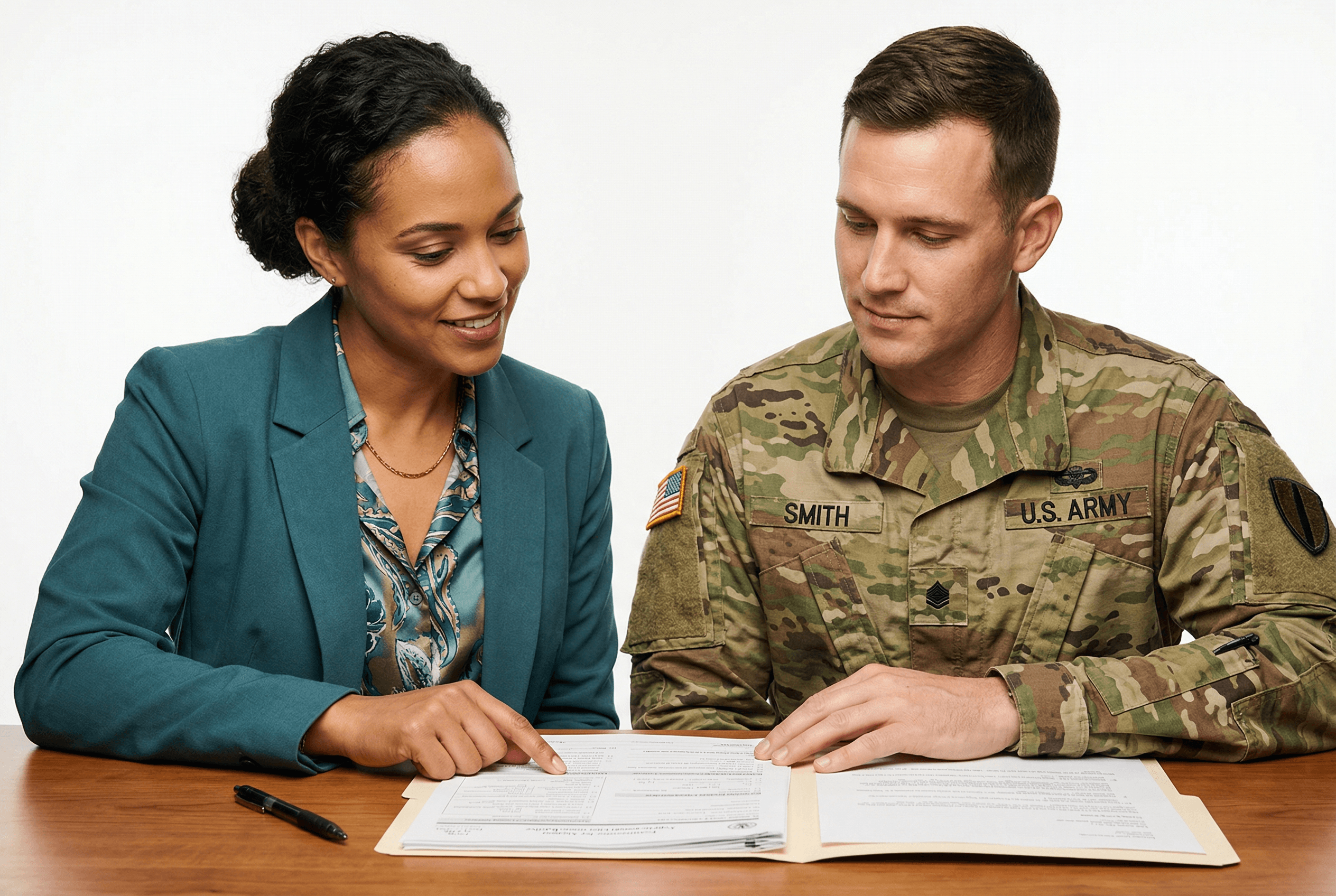
The green card interview is the moment everything comes together. For most couples, it’s nerve-wracking. For military families, it comes with a unique set of dynamics that civilian couples never face.
Deployments. PCS moves. Months or years of separation documented in military orders rather than shared photo albums. The question isn’t whether your marriage is real. It’s whether you know how to present your evidence in a way that makes that obvious to the officer across the table.
I’ve prepared dozens of military families for this interview, and the difference between a smooth approval and an unnecessary Request for Evidence often comes down to preparation.
Why Military Cases Are Different
In a standard marriage-based green card interview, USCIS is looking for evidence that your marriage is genuine. They want to see shared finances, a shared address, photos together, and a consistent story about your life as a couple.
Military families check those boxes differently. You might not have lived together for months at a time. Your "shared address" might be a barracks or base housing that only one of you occupies while the other is overseas. Your financial evidence might be allotment records and BAH (Basic Allowance for Housing) enrollment rather than a joint checking account.
None of that is a problem, as long as you know how to present it.
The Military Evidence That Strengthens Your Case
Military families have access to documentation that most civilian couples can’t produce. When organized correctly, these records tell a compelling story.
Deployment Orders
Deployment orders explain gaps. If you and your spouse lived apart for eight months, a set of deployment orders turns that gap from a red flag into a non-issue. Bring copies of every set of orders that overlaps with your relationship timeline.
BAH (Basic Allowance for Housing) Enrollment
When a service member enrolls a spouse as a dependent for BAH purposes, it’s a financial commitment documented by the Department of Defense. This is strong evidence of a bona fide marriage. USCIS officers understand what BAH dependent status means.
DEERS (Defense Enrollment Eligibility Reporting System) Registration
Registering your spouse in DEERS gives them access to military healthcare, commissary privileges, and base access. It requires documentation of the marriage and is verified by the military. DEERS registration is one of the most persuasive pieces of evidence in a military green card case.
On-Base Housing Documents
If you lived in on-base family housing, those records show cohabitation in a way that’s hard to dispute. Housing applications, lease agreements, and move-in documentation all support your case.
Military Power of Attorney
A power of attorney executed before deployment shows trust and shared responsibility. It demonstrates that the service member entrusted significant legal authority to their spouse, something you don’t do in a marriage of convenience.
Family Care Plans
If you have children, the Family Care Plan filed with your unit designates your spouse as the caregiver during deployments. It’s another layer of official documentation showing a functioning family unit.
How to Explain Deployments Without Raising Red Flags
This is where preparation matters most. USCIS officers will notice gaps in cohabitation. In a civilian case, a year of living apart might raise questions. In a military case, it’s expected, but you still need to address it directly.
Here’s what I tell every military family I prepare:
- Be specific, not vague. Don’t say "I was deployed." Say "I deployed to Kuwait with the 3rd Infantry Division from March 2024 through November 2024 under these orders."
- Show how you stayed connected. Phone records, video call logs, messaging history, letters. Evidence of consistent communication during separation reinforces that the relationship continued.
- Document financial support. Allotment records showing money sent to your spouse during deployment, BAH enrollment, and any joint financial activity during the separation period.
- Bring leave records. If you took leave to visit your spouse during or between deployments, those records show effort to maintain the relationship despite military obligations.
The goal isn’t to hide the separation. It’s to show that the separation was military-driven and that your relationship continued through it.
What USCIS Officers Look for in Military Cases
Officers who handle military family cases generally understand the lifestyle. But they’re still evaluating credibility, and they look for:
- Consistency between your stories. Both spouses should describe the relationship timeline, deployment history, and daily life in a way that matches.
- Documentation that fills gaps. Every period of separation should have a military explanation supported by paperwork.
- Evidence of a shared life outside the military. Photos, messages, trips together during leave, meeting each other’s families. The military documents prove logistics; the personal evidence proves connection.
- An honest explanation for quick timelines. Military couples sometimes marry quickly due to deployment schedules or PCS orders. That’s understood, but you should be ready to explain the timeline honestly and show that your relationship existed before the time pressure.
What to Bring: The Military Family Document Checklist
Beyond the standard green card interview documents, military families should bring:
- DD-214 (Certificate of Release or Discharge from Active Duty) or current service records
- All deployment and PCS orders covering the relationship period
- BAH enrollment documents showing dependent status
- DEERS registration confirmation
- On-base housing agreements (if applicable)
- Military power of attorney (if executed)
- Family Care Plan (if applicable)
- Leave and Earnings Statements (LES) showing allotments
- Communication records during deployments
- Photos from military events, homecomings, and leave periods
Organize everything chronologically. Officers appreciate a clean, logical presentation.
How I Prepare Military Families Differently
When I work with a military family at Occam, the preparation process looks different from a standard case.
First, we do a full review of the service member’s military records alongside the immigration file. I’m looking for how the military timeline intersects with the relationship timeline, where the gaps are, what documents explain them, and what additional evidence we need.
Then we do a mock interview. Not a generic one. I ask the questions an officer would ask about your specific military situation. Why did you marry two weeks before deployment? How did you maintain your relationship during a 12-month tour? Why is your spouse’s address different from yours on these forms?
By the time you walk into that interview, you’ve already answered every hard question at least once.
Your Next Step
If your green card interview is coming up and military service is part of your story, preparation is the difference between walking out with an approval and walking out with a stack of follow-up requests.
Contact our team to schedule interview preparation. We’ll review your military records, build your document package, and make sure you’re ready for every question.