
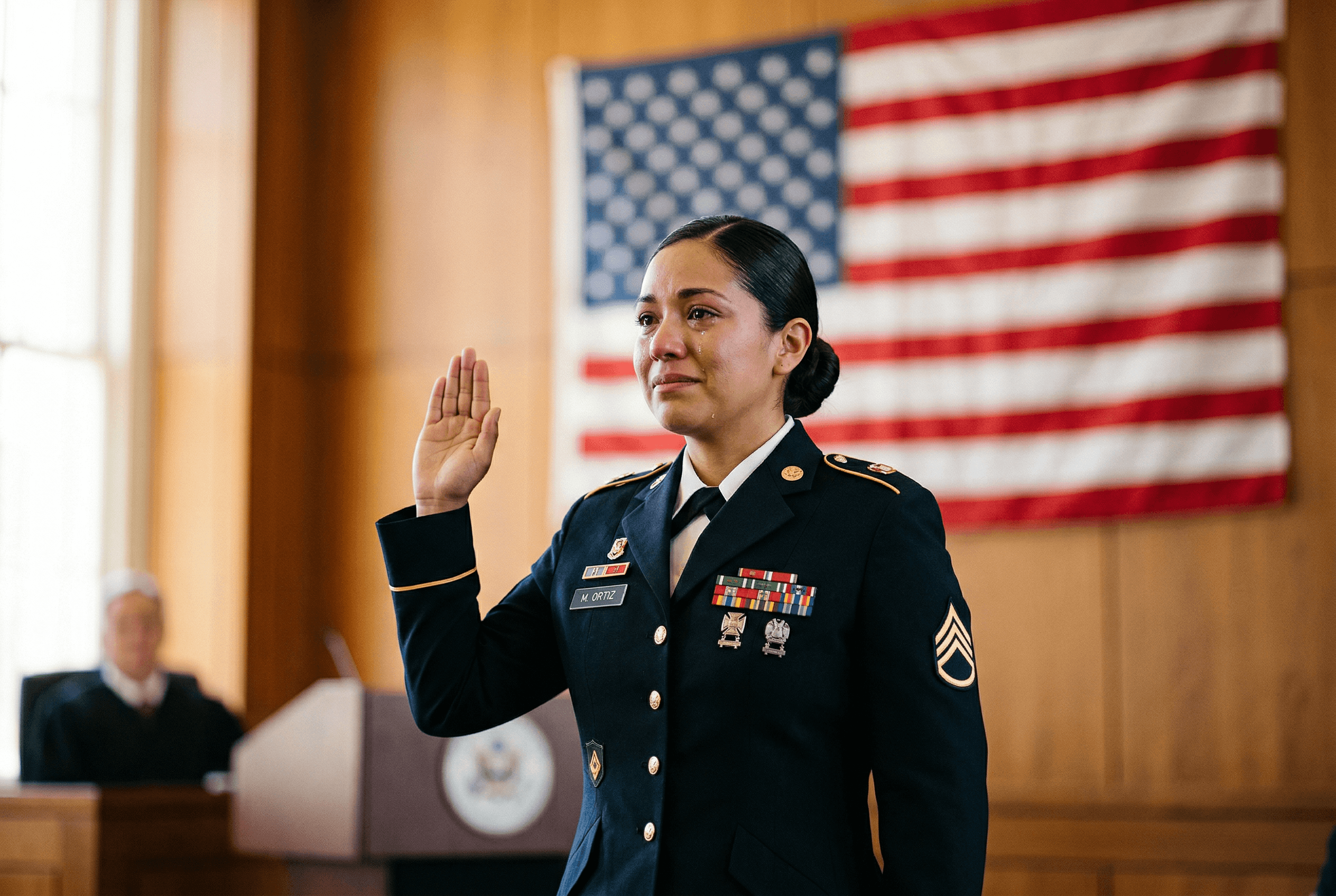
Most service members don't know that military service unlocks naturalization pathways that are fundamentally different from, and significantly faster than, the civilian process. Two provisions of the Immigration and Nationality Act, §328 and §329, reduce or eliminate the residency and physical presence requirements that slow down standard naturalization. And those benefits extend beyond the service member to spouses and, in some cases, children.
This guide breaks down who qualifies, what each pathway requires, and how to navigate the filing process, whether you're active duty, a veteran, or a military spouse.
INA §328: Peacetime Military Naturalization
INA §328 is the baseline military naturalization provision. It applies to service members who have completed at least one year of honorable service in the U.S. armed forces — Army, Navy, Air Force, Marine Corps, Space Force, Coast Guard, or certain components of the National Guard and Selected Reserve.
Who Qualifies
To naturalize under §328, you must be a lawful permanent resident (green card holder) who has served honorably for at least one year. You must be either currently serving or have been honorably discharged within the past six months. If more than six months have passed since your discharge, you may still qualify, but standard residency requirements could apply.
Reduced Residency and Physical Presence Requirements
Under the standard civilian pathway, you need five years of continuous residence in the United States and at least 30 months of physical presence. INA §328 changes the equation significantly. Your military service counts toward both the residency and physical presence requirements. You don't need to maintain residence in any particular state — critical for service members who PCS frequently. And time spent overseas on military orders counts as time in the United States for naturalization purposes.
How to File
File Form N-400 (Application for Naturalization) with Form N-426 (Request for Certification of Military or Naval Service). The N-426 must be completed and signed by an authorized military official certifying your service dates and discharge characterization. Active duty applicants file their N-400 at the USCIS office with jurisdiction over their duty station. If filing while stationed overseas, you can request that your interview and oath ceremony be conducted at a U.S. embassy or consulate.
Active duty service members are exempt from the N-400 filing fee. Veterans may also qualify for a fee waiver depending on their circumstances.
INA §329: Wartime and Hostile Fire Naturalization
If §328 is the standard military fast lane, §329 is the express lane. This provision applies to anyone who has served honorably during a designated period of hostility — and it eliminates virtually every barrier to naturalization.
Who Qualifies
You qualify under §329 if you served honorably in the U.S. armed forces during a designated period of hostility. The most relevant current designation is the period beginning September 11, 2001, which remains active. This means every service member who has served since 9/11 — regardless of branch, MOS, or deployment status — potentially qualifies for §329 benefits.
Unlike §328, you do not need to be a lawful permanent resident. Non-citizen service members — including those who entered on a visa and never adjusted status — can naturalize directly under §329 if they meet the service requirement.
What §329 Eliminates
The benefits under §329 are extraordinary compared to the civilian pathway:
- No residency requirement — you don't need to have lived in the U.S. for any specific period
- No physical presence requirement — time spent overseas on deployment counts fully
- No specific state residency requirement — PCS moves don't affect your eligibility
- No LPR requirement — you can naturalize even if you are not a green card holder
- Immediate eligibility — you can file as soon as you have qualifying service
Current Designated Periods of Hostility
The President designates periods of hostility by Executive Order. The current active designation began on September 11, 2001, and has not been terminated. Previous designated periods include World War I, World War II, Korea, Vietnam, the Persian Gulf conflict (August 2, 1990 – April 11, 1991), and several others. For most current service members and recent veterans, the post-9/11 designation is the relevant one.
Military Spouse Naturalization
Military spouses aren't eligible for §328 or §329 directly — those provisions apply only to the service member. But spouses have their own accelerated pathways, and the combination of military-specific accommodations can significantly shorten the timeline.
The 3-Year Residency Pathway
If you are married to a U.S. citizen who is an active duty service member, you may qualify for naturalization after just three years of permanent residence instead of the standard five. You must have been married to the U.S. citizen spouse for the entire three-year period, lived in marital union during that time, and your spouse must have been a U.S. citizen for the entire period. This pathway is available under INA §319(a) — the same provision available to all spouses of U.S. citizens, but particularly valuable for military families because the timeline aligns with typical PCS tour lengths.
Expedited Processing and Deployment Accommodations
USCIS offers expedited processing for immediate family members of active duty service members. If your service member spouse is deploying and you need to complete your naturalization before they leave, you can request expedited scheduling of your biometrics appointment and interview. If your spouse is already deployed and cannot attend your interview, USCIS typically does not require the petitioning spouse to be present at a naturalization interview — but having a Power of Attorney in place ensures your attorney can handle any complications that arise.
Power of Attorney During Deployment
If the service member is the one naturalizing and gets deployed mid-process, a Power of Attorney can allow their attorney to handle certain administrative tasks. However, USCIS generally requires the applicant to appear in person for the naturalization interview and oath ceremony. Planning around known deployment windows is essential — which is why working with an attorney who understands military timelines is critical for military families.
Derivative Citizenship for Military Children
Children of U.S. citizen service members may acquire citizenship automatically under INA §320, without needing to file a separate naturalization application. This is particularly relevant for military families because children are frequently born overseas at military hospitals or in foreign countries during an overseas assignment.
INA §320 Automatic Citizenship
Under INA §320, a child born outside the United States automatically becomes a U.S. citizen when all of the following conditions are met: at least one parent is a U.S. citizen, the child is under 18 years old, the child is a lawful permanent resident, and the child resides in the United States in the legal and physical custody of the U.S. citizen parent. For military families, residence at an overseas military installation can satisfy the "residing in the United States" requirement in certain circumstances.
Documentation Requirements
To document derivative citizenship, you'll need the child's birth certificate (foreign or domestic), evidence of the parent's U.S. citizenship (passport, naturalization certificate, or birth certificate), evidence of the child's lawful permanent resident status, and evidence of legal and physical custody. File Form N-600 (Application for Certificate of Citizenship) to obtain a Certificate of Citizenship as proof.
Aging Out Concerns
The automatic citizenship provision under §320 only applies to children under 18. If a child turns 21 before obtaining lawful permanent resident status, they may age out of derivative benefits entirely. For military families, this is a real risk when deployments or PCS moves delay the underlying green card petition. If your child is approaching 18 or 21 and you have pending immigration applications, consult an attorney immediately to evaluate the timeline and explore protective strategies.
N-400 Filing with Military Documentation
Filing for military naturalization requires the same N-400 form as civilian naturalization, but with additional military-specific documentation. Getting the paperwork right from the start avoids delays that can collide with deployment schedules or PCS orders.
Required Documents
In addition to the standard N-400 supporting documents (green card, passport photos, tax returns), military applicants should prepare:
- Form N-426 (Request for Certification of Military or Naval Service) — must be signed by an authorized military official, typically through your base's personnel office or S-1/G-1
- DD-214 (Certificate of Release or Discharge from Active Duty) — for veterans. Must show honorable or general under honorable conditions discharge characterization
- NGB-22 (Report of Separation and Record of Service) — for National Guard members
- Deployment orders and service records — especially for §329 claims, where you need to demonstrate service during a designated period of hostility
- Military personnel records — including any evidence of awards, commendations, or service history that supports your good moral character determination
Form N-426: What You Need to Know
The N-426 is the document that bridges your military service and your naturalization application. It certifies your dates of service, branch, and discharge characterization. You submit it to your base personnel office or S-1, and they return it with the official certification. This can take anywhere from a few days to several weeks depending on your installation — start this process early. If you are a veteran and your personnel office is no longer accessible, you can request service records through the National Personnel Records Center (NPRC) in St. Louis, though this can take 60 to 90 days or longer.
Common Documentation Mistakes
The most common errors in military naturalization filings include submitting an N-426 without the required official signature, using a DD-214 that shows a discharge characterization other than honorable without addressing it in the application, failing to include deployment records needed for a §329 claim, and waiting too long after discharge to file (which can affect §328 eligibility). An experienced immigration attorney will ensure your military documentation package is complete before filing.
Application Fee Waivers
One of the practical benefits of military naturalization is the potential to waive the N-400 filing fee entirely.
Active Duty Service Members
If you are currently serving on active duty, the N-400 filing fee is automatically waived. You do not need to submit a separate fee waiver request — simply indicate your active duty status on the form and include your N-426 certification. The biometrics fee is also waived for active duty applicants.
Veterans
Veterans who have been honorably discharged may also qualify for a fee waiver, though the criteria differ from active duty members. Veterans filing under §328 or §329 with qualifying service are generally eligible for the filing fee waiver. If you are a veteran filing under the standard civilian pathway (because you no longer qualify for military naturalization), you may still request a fee waiver based on financial hardship using Form I-912. Your DD-214 and any VA disability documentation can support the request.
How Occam Helps Military Families Naturalize
Military naturalization cases aren't inherently more complex than civilian ones — but they operate under constraints that most immigration attorneys don't plan around. Deployment windows close. PCS orders arrive mid-case. Interview dates conflict with training schedules. The law gives military families significant advantages, but only if the filing is structured to survive the unpredictability of military life.
Fast-Track-to-Filing for Military Cases
Occam's Fast-Track-to-Filing methodology is built for exactly this kind of constraint. We front-load the documentation phase — gathering your N-426, DD-214, deployment records, and supporting evidence before the N-400 is filed. That means when the application goes in, it's complete. No RFEs. No scrambling for documents during a deployment. No delays caused by missing signatures from a personnel office you've already PCS'd away from.
Deployment-Aware Scheduling
We build your naturalization timeline around your military calendar, not the other way around. If you know your deployment window, we time the filing so that your interview and oath ceremony fall within your stateside availability. If PCS orders arrive mid-case, we manage the jurisdiction transfer immediately — not after it becomes a problem.
Virtual-First for PCS Flexibility
Occam's model is virtual-first, which means your case moves with you. Whether you're at Joint Base Charleston, Camp Pendleton, Fort Liberty, or stationed overseas, your attorney and your case file are accessible from anywhere. No in-person office visits required during the preparation phase. When it's time for your USCIS interview, we prepare you thoroughly regardless of which field office has jurisdiction.
Your service opened the door to an accelerated path to citizenship. Occam makes sure you actually walk through it — on schedule, with the right documentation, and without the process falling apart when the military moves you somewhere new.