
Introduction
The marriage-based green card interview is one of the most decisive moments on your path to permanent residence. This face-to-face meeting with a U.S. Citizenship and Immigration Services (USCIS) officer or a consular officer (abroad) allows them to confirm the bona fides of your marriage and verify the accuracy of your application. For many couples, the idea of a formal interview—often accompanied by anxiety over tricky questions—is intimidating.
Here’s the good news: with the right preparation, you can approach your interview with confidence. This guide walks you through the logistics, common questions, key documents, and strategies that will help you succeed. By the end, you’ll understand exactly how to present a strong case and avoid common pitfalls.
Why the Interview Matters
While your application packet, supporting documents, and evidence of a bona fide marriage are critical, the interview is often the decisive test. The interviewing officer will evaluate:
- Marriage Authenticity: Is your relationship genuine, or does it exist primarily for immigration benefits?
- Applicant’s Eligibility: Do you meet all legal criteria for a green card under U.S. immigration law?
- Consistency of Information: Do your answers in person align with your previously submitted forms and documents?
A smooth, successful interview can finalize the process, leading to approval. Conversely, insufficient or contradictory answers may result in Requests for Evidence (RFEs), delays, or even denials.
Where the Interview Takes Place
Adjustment of Status (AOS) in the U.S.
If you’re applying via Adjustment of Status, your interview typically occurs at a local USCIS field office near your U.S. residence. USCIS will notify you of the date, time, and location via an Interview Appointment Notice (Form I-797C).
Consular Processing (CP) Abroad
If you’re going through Consular Processing, the interview happens at a U.S. Embassy or Consulate in the foreign spouse’s country of origin (or residence). The National Visa Center (NVC) coordinates the visa application phase and scheduling.
Note: To decide which route applies to you, see our Step-by-Step Guide to Filing for a Marriage-Based Green Card sub-page and check our Adjustment of Status and Consular Processing master pages.
Interview Timeline & Logistics
Scheduling
- USCIS Field Office: The wait time between filing and interview can range from a few months to over a year, depending on your local field office’s workload.
- Consulate or Embassy: After your documentation is “documentarily qualified” by the NVC, you’ll be given an interview date. Processing times can vary widely based on the embassy or consulate’s backlog.
Checklists & Confirmation
A few weeks (or sometimes just days) before the interview:
- USCIS or NVC Notice: Confirm your appointment date and time, and note any instructions about documents or medical exams.
- Document Review: Double-check that you’ve got all the originals and copies of your critical documents (passport, marriage certificate, birth certificates, etc.).
- Travel Arrangements: If you’re adjusting status in the U.S., plan to arrive early at the USCIS office. For consular interviews, arrange necessary travel to the city where the embassy or consulate is located.
Pro Tip: Consult our Document Checklist & Best Practices for Marriage-Based Green Cards sub-page to ensure nothing slips through the cracks.
Gather & Organize Essential Documents
Required Documents
- Interview Appointment Notice (Form I-797C): This is your proof of a scheduled interview.
- Government-Issued ID & Passports: Include your current passport and any old passports that contain U.S. visas/entry stamps.
- Marriage Certificate (Original + Copy)
- Birth Certificates (Both Spouses)
- Joint Documents: Bank statements, lease/mortgage agreements, utility bills, joint tax returns, insurance policies—anything showing shared finances and cohabitation.
- Latest Tax Returns & Pay Stubs: Particularly if you’re applying via Adjustment of Status.
- Proof of Ongoing Relationship: Recent photos, updated correspondence, or other bona fide evidence.
- Medical Examination Report (If Not Already Submitted): For AOS, that’s usually Form I-693 in a sealed envelope from a civil surgeon. For consular processing, the panel physician provides instructions.
- Affidavit of Support (Form I-864) & Evidence**: Income documents (W-2s, 1099s) or assets, plus any joint sponsor documents, if applicable.
Extra Supporting Materials
- Wedding Photos or Ceremonial Documents: If you had a formal ceremony, pictures can help show you’re a genuine couple.
- Communication Logs: For couples who’ve spent time apart, logs of calls, messages, or emails can be useful if you need to demonstrate an ongoing relationship.
- New Evidence: If your living situation, finances, or family status changed since filing, bring updated documents (e.g., new joint lease or bank account).
CTA: Unsure if your documents are sufficient?
Contact Occam Immigration for a personalized document review before your interview.
Reviewing Your Application & Forms
Before your interview, revisit all the forms you and your spouse submitted:
- Form I-130 (Petition for Alien Relative)
- Form I-485 (Adjustment of Status) or DS-260 (Immigrant Visa Application for Consular Processing)
- Form I-864 (Affidavit of Support)
- Form I-765 (Work Permit) and Form I-131 (Advance Parole), if applicable
Make sure you’re familiar with every detail—like the dates you met, places you’ve lived, job history, and any travel outside the U.S. Officers often ask questions based on these forms to check for consistency and accuracy.
Common Interview Questions
While every interview is unique, certain recurring themes often arise in marriage-based cases:
- Relationship History
- How did you meet?
- When did your relationship become romantic?
- Who proposed, and how did the proposal happen?
- Daily Life & Routine
- Who pays the bills, and how are expenses shared?
- Where do you live, and who lives there with you?
- Do you plan to have children (if you don’t already)?
- How do you split chores?
- Family & Social Ties
- Have you met each other’s families?
- Do you spend holidays or vacations together?
- What activities do you do as a couple?
- Wedding & Reception Details
- Date and location of your wedding.
- Who attended, and how many guests?
- Did you have a honeymoon?
- Future Plans
- Where do you see yourselves living long-term?
- Are you planning to buy a house?
- Any upcoming trips or special occasions?
- Potentially Sensitive Topics
- Prior marriages or children from previous relationships.
- Financial or legal issues (bankruptcy, arrests, etc.).
- Health concerns and insurance coverage.
Pro Tip: If you suspect certain areas might raise questions (like an age gap, short engagement, or cultural differences), be ready to explain the circumstances calmly and honestly.
Tips for Demonstrating a Bona Fide Marriage
Consistency & Honesty
The most effective way to show a genuine relationship is to answer truthfully and consistently. If you’re uncertain about a specific date or detail, it’s acceptable to say “I don’t recall precisely” rather than guess and potentially contradict the record.
Body Language & Demeanor
- Be Respectful: Greet the officer politely, maintain good eye contact, and avoid fidgeting with documents or personal items excessively.
- Stay Calm: Even if faced with rapid or seemingly intrusive questions, keep your composure.
Cultural & Language Differences
- If English isn’t your or your spouse’s first language, you may be allowed to bring an interpreter (for USCIS) or use the consulate’s translator abroad, depending on location. Check the local rules well in advance.
Joint Interview vs. Stokes Interview
- Standard Joint Interview: Usually, the couple sits together, and the officer asks questions to both at the same time.
- Stokes Interview: If the officer suspects fraud, they may separate you for individual questioning. Each spouse answers the same set of questions, and the officer compares the responses.
Important: Don’t panic if you’re separated. Stay calm and consistent with your account of dates, events, and daily habits.
Red Flags & Potential Pitfalls
Certain factors may prompt the officer to be more probing:
- Large Age Differences: While not automatically suspicious, couples with significant age gaps should be ready to discuss how they met and fell in love.
- Short Engagement or Fast Marriage: If you tied the knot after a brief courtship, expect questions on why you moved quickly.
- Sparse Joint Documents: Not sharing a lease or finances can appear suspicious, though it may be explainable with the right context (e.g., cultural reasons or not yet merging finances).
- Prior Visa Violations: Overstays or past visa denials can lead to deeper scrutiny of your current situation.
- Previous Marriages: If either spouse has had multiple prior marriages, the officer might want more evidence that this one is genuine.
Honesty is the best approach. If the officer discovers omissions or false statements, it can severely harm your credibility and result in denial.
On the Day of the Interview
Arrival
- Arrive 30 minutes early, factoring in time for parking, security checks, and unexpected delays.
- Dress in business casual or semi-formal attire. You should look neat and respectful, without appearing overly dressed for the occasion.
Security & Check-In
- At a USCIS office, you’ll go through a security checkpoint similar to an airport. Phones are usually allowed but must be on silent.
- In a consulate, security can be more stringent. Check the embassy’s website in advance for guidelines on electronics and personal items.
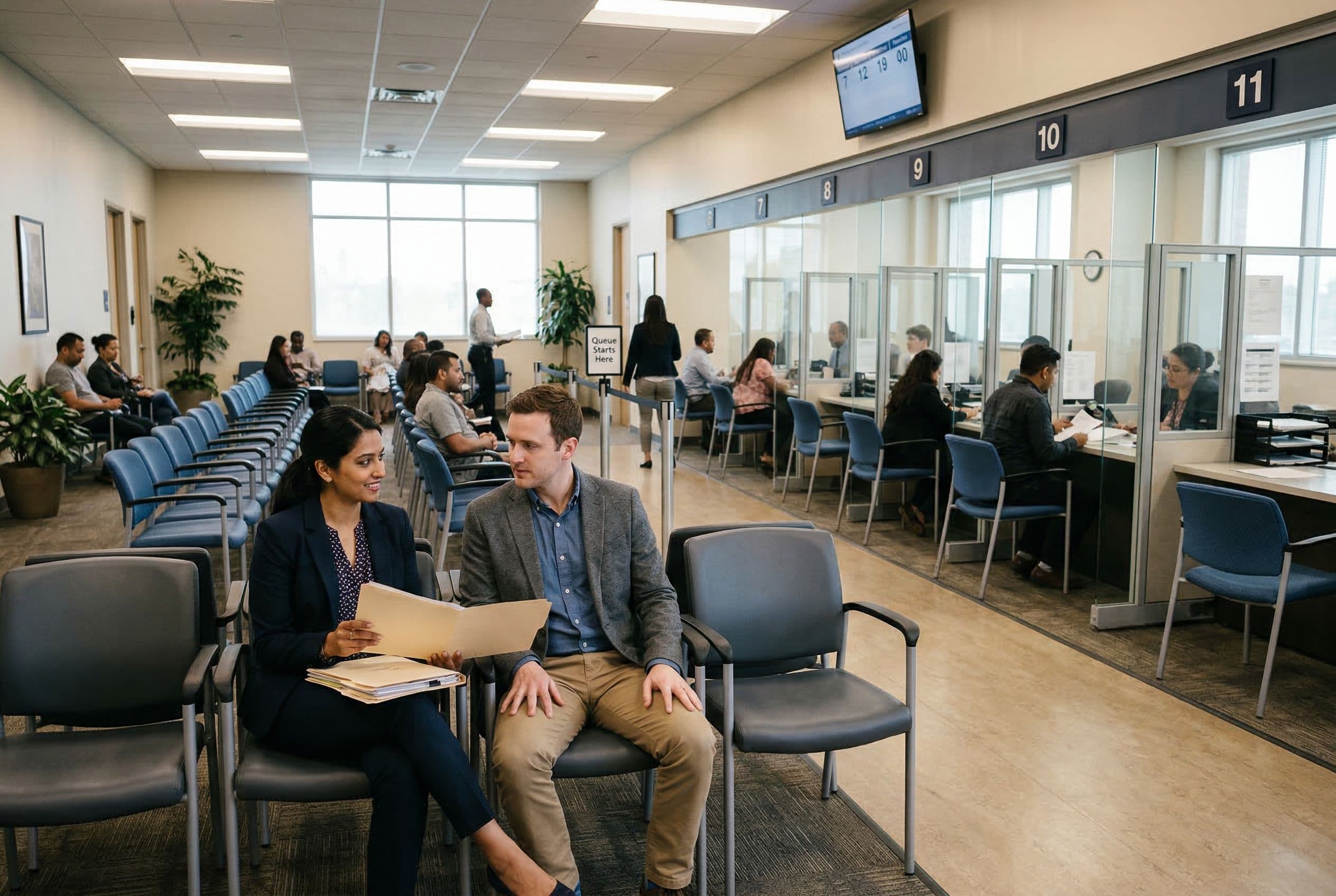
Waiting Room Etiquette
- Keep your documents organized in a folder or binder.
- Avoid discussing personal matters loudly.
- Listen for your name or case number to be called.
Meeting the Officer
- Offer a polite greeting (e.g., “Good morning, Officer”).
- If asked to raise your right hand, you’ll swear to tell the truth.
- Hand over any requested documents.
- Answer questions calmly and thoroughly.
Pro Tip: If you need clarification, politely ask, “Could you please restate the question?” to ensure you understand what’s being asked.
Possible Interview Outcomes
Approval on the Spot
Some officers may approve your case immediately, verbally informing you of the decision. If you’re adjusting status, you might see your online status updated to “New Card Is Being Produced” within days.
Request for Additional Evidence (RFE)
If the officer finds gaps in your documentation—like missing financial records or insufficient proof of a bona fide marriage—they might issue an RFE. You’ll have a deadline to submit the requested items.
Notice of Intent to Deny (NOID)
If the officer suspects fraud or finds significant eligibility issues, they could issue a NOID. You’ll have a chance to respond and address their concerns before a final decision.
Administrative Processing (Consular Cases)
For consular interviews, a case can be placed under administrative processing (also known as “221(g)”) for further background checks. This can add weeks or months to the timeline.
Denial
In serious cases (suspected marriage fraud, major eligibility problems, or failure to provide requested documents), the officer may deny your application. You can explore an appeal or a Motion to Reconsider in some instances.
Further Reading: For strategies on dealing with RFEs, NOIDs, and denials, see our Common Obstacles & How to Overcome Them sub-page.
After the Interview
Monitoring Case Status
- If you get an approval, you might receive your green card in the mail (for AOS cases) or an immigrant visa in your passport (for consular cases) within a few weeks.
- For any additional steps (like an RFE), respond by the specified deadline to keep your case moving.
Conditional vs. Permanent Green Card
- Conditional (2-Year) Green Card: If your marriage is under two years old at approval, you’ll receive a conditional card. You must file Form I-751 to remove conditions within 90 days before its expiration.
- Permanent (10-Year) Green Card: Marriages older than two years at the time of approval result in a standard 10-year card.
For more details on conditional residency, see our sub-page on Conditional Green Cards & Removing Conditions (I-751).
Why Choose Occam Immigration?
With the immigration interview often being the make-or-break moment, experienced guidance can significantly improve your chances of a smooth approval. At Occam Immigration, we provide:
- Customized Preparation: We assess your unique history, helping you anticipate specific questions and gather the right evidence.
- Fast-Track-to-Filing Approach: From the initial application to final interview prep, we streamline the process to minimize delays.
- Peace of Mind: Our seasoned attorneys are available to address last-minute concerns, review your documentation, or even accompany you (if allowed) for extra reassurance.
CTA: Don’t navigate this critical step alone.
Schedule a consultation with Occam Immigration to secure tailored interview guidance.
Putting It All Together
By the time you reach the interview stage, you’ve already invested considerable effort in gathering documents and proving your marriage’s authenticity. Think of the interview as the final checkpoint: come prepared, stay calm, and tell your story truthfully. Officers are trained to distinguish genuine marriages from fraudulent ones, and a well-prepared couple can make a lasting, positive impression.
Next Steps
- Confirm Your Appointment: Note the time, date, and location.
- Review & Organize: Cross-check your forms, review potential questions, and ensure all relevant documents are updated.
- Practice: Talk through key relationship milestones with your spouse to maintain consistency.
- Stay Informed: For general process guidelines, revisit our Marriage-Based Green Card Step-by-Step Guide.
- Seek Support: If you have complex issues or simply want peace of mind, contact Occam Immigration.
With the right mindset and preparation, the marriage-based green card interview can become a positive, conclusive step toward building your life together in the United States.