

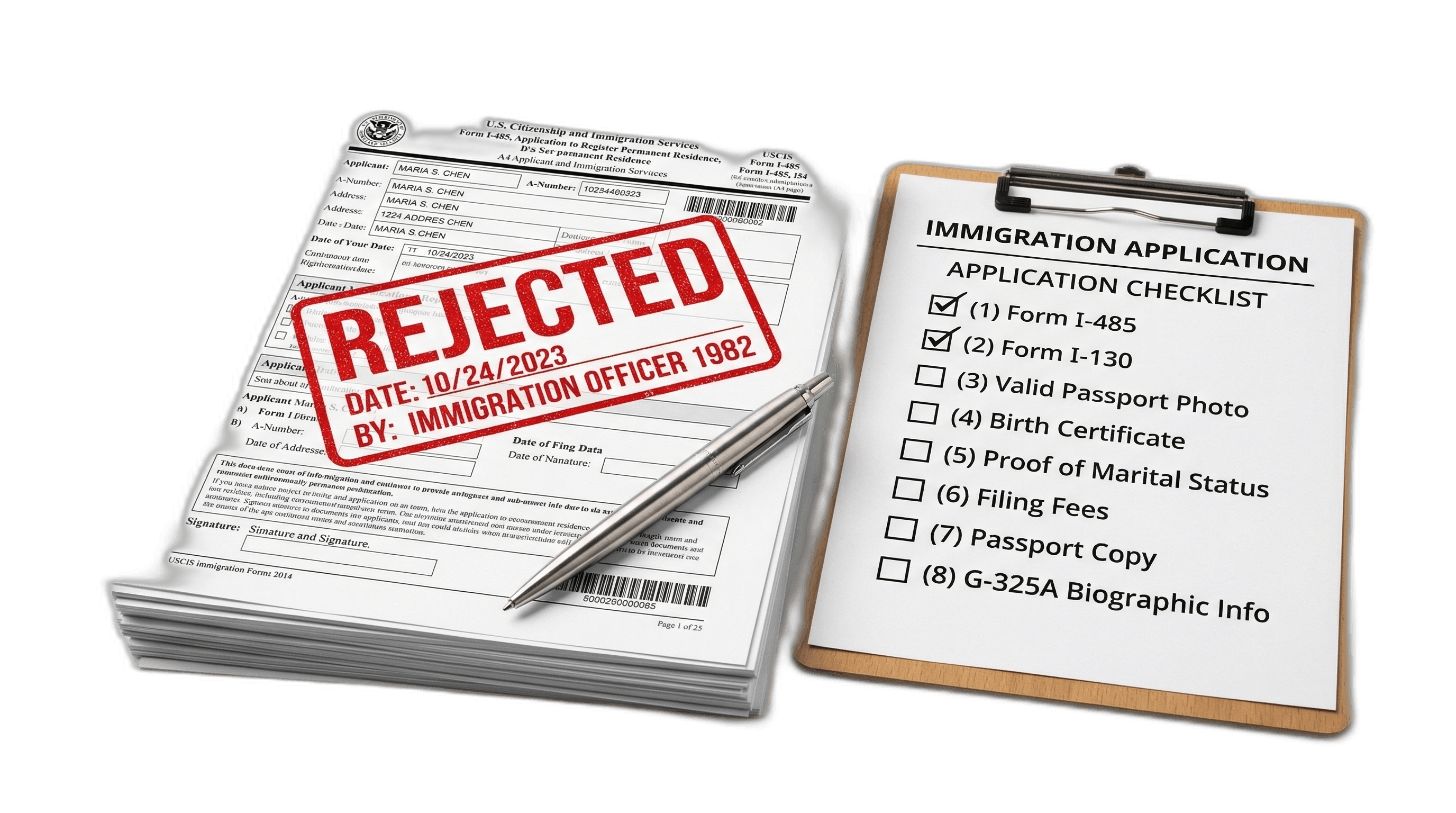
As an immigration attorney who’s guided many couples through this journey—and even navigated some of these challenges in my own life—I know how confusing the marriage-based green card process can feel. From collecting the right paperwork to proving your marriage is genuine, it’s easy to make a misstep.
But here’s the upside: these common mistakes are totally avoidable once you know what to look for. In this article, I’ll share the most frequent pitfalls couples encountered before they came to me for help to fix them — and give you tips to ensure your own case stays on track from the get-go.
Overlooking the Proof of a Genuine Marriage
Why This Matters:Early in my practice, I met a couple who filed on their own. They assumed their marriage certificate was enough proof—until they got a Request for Evidence (RFE) asking for joint bank statements, leases, and other documents to show they truly shared a life. By the time they found me, they were frustrated, overwhelmed, and worried about losing their money.
How to Avoid It:
- Gather Real-Life Evidence: USCIS looks for more than a license; they want to see joint accounts, shared bills, photos with friends and family, and anything else that ties your life together.
- Label Photos & Documents: A short description of who’s in the photo and the date/event can help immigration officers see the full picture.
- Explain Unique Situations: If you’re long-distance or follow cultural practices that might not be obvious (like separate finances), include a brief note explaining why.
Personal Tip: I often advise couples to build a simple “relationship timeline.” It helps you stay consistent on forms and in interviews, especially if you’ve had multiple moves or job changes.
Rushing the Paperwork Without Understanding the Basics
Why This Matters:I've worked with more than a few couples who came to me after they tried to file everything at lightning speed to “get it over with.” They overlooked questions and left out important details, which led to significant delays. Some had their application packages rejected by USCIS, some had lengthy RFEs, and one was investigated by the fraud unit.
How to Avoid It:
- Read the Main Forms: I-130, I-485, and the instructions might seem long, but a thorough read can save you months of back-and-forth.
- Use Checklists: They keep you on track and help ensure nothing slips through the cracks.
- Ask for Help Sooner: If you’re confused by any requirement, consult an attorney or a trusted source before you submit.
Personal Tip: Many people don’t realize how much USCIS scrutinizes the application forms. Don't avoid questions because you don't understand them or because they take a lot of work to answer thoroughly.
Ignoring the Financial Requirements
Why This Matters:This is the #1 most common RFE I see! USCIS is very particular about this part of the application, but the instructions can be so confusing. The worst part is that the RFE on Form I-864 is always written in boilerplate language, so you never really know where your I-864 went wrong.
How to Avoid It:
- Understand Your Income: For W-2 employees, this is easy. If you're self-employed, your income is NOT your business's revenue. If your income is borderline, gather extra evidence or consider a joint sponsor.
- Get the RIGHT Records: DON'T USE COPIES OF TAX RETURNS YOU PREPARED! Get your tax return transcripts from IRS.gov. Make sure your proof of assets is well documented.
- Plan for a Joint Sponsor: Ask a financially qualified friend or relative for help, if needed. It’s completely acceptable.
Personal Tip: Think of the Affidavit of Support as a serious commitment—it’s not just another form. If you have any doubts about meeting the requirement, bring in a joint sponsor from the start.
Using Old or Incomplete Forms
Why This Matters:This happens more often than you would think. People download and complete forms, put their case on hold, and then file the package later only to get their entire application and evidence returned with a rejection notice because the forms were out of date. Lately, forms filed in the Marriage-Based Green Card applications have been changing more frequently, especially during changes in administrations and regulations.
How to Avoid It:
- Visit the Official USCIS Website: Download forms directly from there to ensure you have the correct revision date. Before filing, go to the USCIS form's webpage and verify your completed forms' edition dates are acceptable. Edition dates are on the bottom left corner of the forms. Also check that every page of the form has the same edition date.
- Double-Check Signatures & Dates: A missing signature can invalidate your entire submission.
- Stay Organized: Keep a folder on your computer (or a physical binder) for each form, labeling everything clearly so you don’t mix up versions.
Personal Tip: Don't prepare your forms until you are absolutely certain you are close to filing, and then download and complete the forms.
Conflicting Details Across Forms
Why This Matters:One couple came to me after getting an RFE because their I-130 listed one address while their I-485 listed another. They’d moved recently and forgot to update the second form. Small oversight—big issue.
How to Avoid It:
- Maintain a Master Timeline: Keep track of every address, job, and important relationship milestone so you’re consistent across all forms.
- Cross-Check Your Own Paperwork: Do a final read-through to ensure no contradictions (like mismatched move-in dates or different job start dates).
- Explain Changes Clearly: If something truly changed (like a sudden move), include a short note in your application packet.
Personal Tip: Even if you don’t consider yourself “organized,” a basic spreadsheet or note on your phone can save you from a big headache later.
Not Preparing for the Interview
Why This Matters:A couple once came to me after a nerve-wracking interview where they got flustered by detailed questions. They realized too late that they hadn’t reviewed their forms or gathered updated evidence, and the interviewing officer separated them to interview them each individually because he suspected it was not a genuine marriage.
How to Avoid It:
- Review Everything: Make sure both spouses know the contents of all filed forms (like I-130, I-485, or DS-260) and can answer questions about your relationship timeline.
- Bring Updated Documents: If you’ve opened new joint accounts, moved, or taken a big trip together, show it.
- Relax but Be Consistent: It’s natural to be nervous. Remember, the interviewer just wants to confirm your relationship is real.
Personal Tip: Treat your interview like an important appointment—because it is. Arrive early, dress modestly, and speak honestly. A little preparation goes a long way.
Missing Deadlines or Not Checking the Mail
Why This Matters:I can’t tell you how many times I’ve heard, “We never got the notice,” only to learn the couple moved and didn’t update their address. By the time they asked me for help, they’d missed an RFE deadline and their application got denied or missed a biometrics appointment delaying their work authorization by months.
How to Avoid It:
- Mark Important Dates: Use a shared calendar (Google, iCal, etc.) to track interviews, biometrics, and filing deadlines.
- Update Address Immediately (AR-11): If you move, let USCIS know within 10 days.
- Check Your Application Case Status Online: You receive a receipt notice for each application form you file, which has a unique Receipt Number. Check your case status on the USCIS website.
- Create a USCIS Online Account: These days, USCIS sends you an online account access code so you can add your paper-filed application to your USCIS online account. You can track your case status and see when action is taken, and in some cases review notices right in your account before they arrive by mail.
- Check Your Mail & Email: Notices still arrive via snail mail, so keep an eye on that mailbox every day.
Personal Tip: If you suspect a notice might be missing, follow up with USCIS or check your online account. It’s better to confirm than to accidentally miss a deadline.
Wrapping It Up: Keep Calm & Stay Prepared
I’ve worked with couples from all walks of life—some who tried to handle everything solo, made a few mistakes, and then came to me for help. While every journey is unique, the common theme is this: a little forethought and organization save you a lot of stress in the long run.
Here’s what I hope you take away:
- Show real evidence of your marriage—beyond just a certificate.
- Slow down and understand each step before hitting “send.”
- Respect the financial requirements (and get help if needed).
- Use current forms and keep details consistent.
- Approach your interview with confidence (and updated documents).
- Don’t let deadlines or address changes catch you off guard.
You can do this. If you ever feel stuck or need a second opinion, I’m just a call or email away.
Reach out to Occam Immigration for personalized guidance, especially if you’ve run into any of these pitfalls. I’m here to help you simplify the toughest parts so you can enjoy the next chapter of your life together—stress-free.